
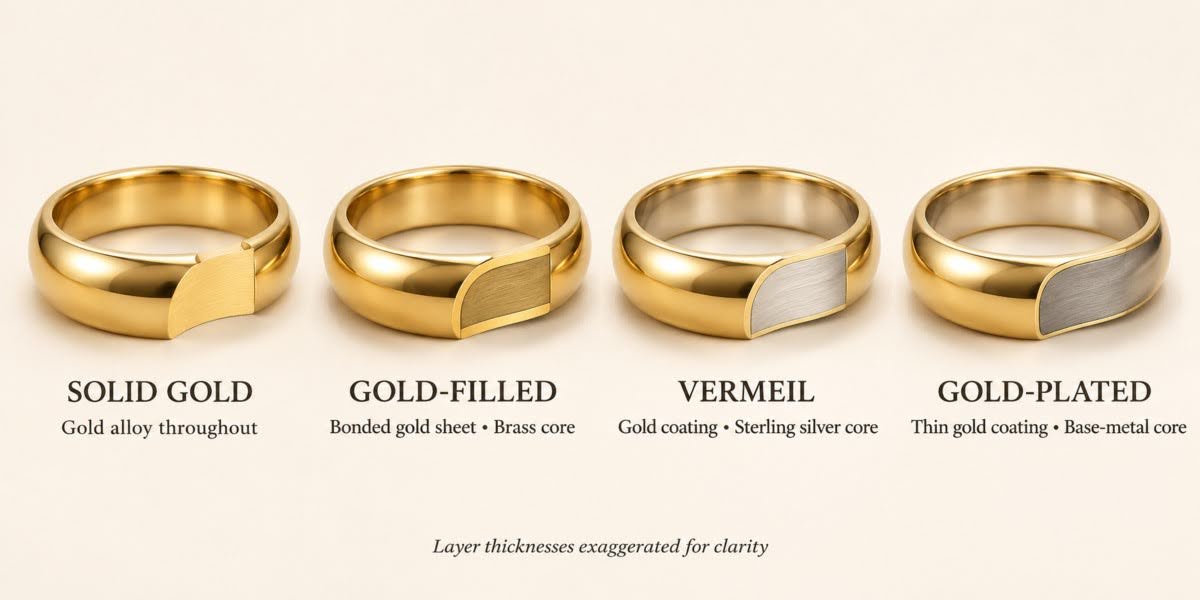
Two gold necklaces can sit side by side in a display case, look identical, and still be built in completely different ways. One is gold alloy all the way through. The other is a skin of gold over brass, copper, or sterling silver.
That’s the real difference between solid gold, gold-filled, vermeil, and gold-plated jewellery: solid gold is gold alloy throughout, while the other three put gold on the surface of another metal, in different ways and different amounts. The right choice depends on how often you’ll wear the piece, whether you’ll want it repaired someday, and how much of the price you want going toward actual gold.
This guide compares all four, explains what their labels mean under Canadian marking rules, and shows you what to check in a listing before you pay.
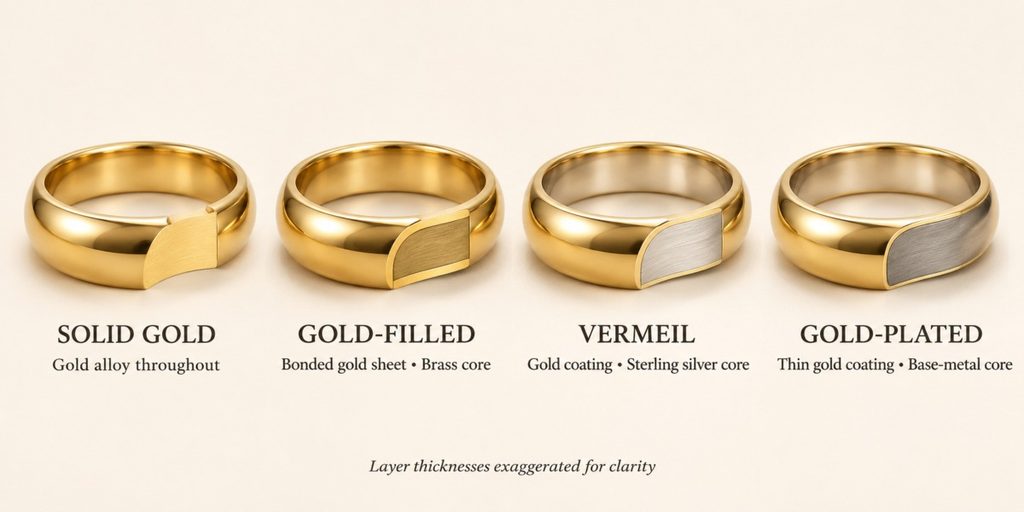
Four Gold Jewellery Types Compared
The fastest way to tell these four apart is to ask where the gold actually sits.
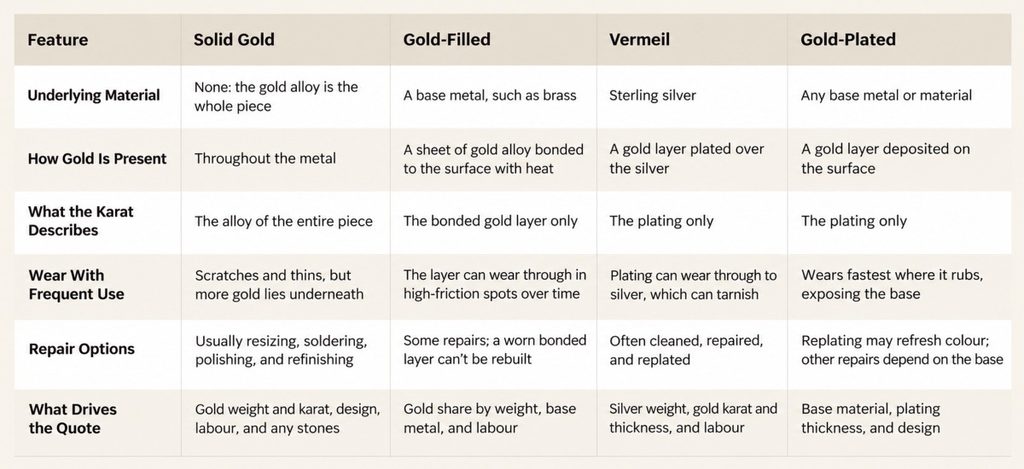
Gold Vermeil vs. Gold Plated
Both put gold on the surface. Vermeil adds a promise about what’s underneath: sterling silver rather than whatever base the maker chose.
Gold Filled vs. Gold Plated
Canadian rules tie gold-filled jewellery to a minimum share of gold by weight, while plating has no weight or thickness floor, so gold-filled usually has far more gold to lose before the base shows.
Solid Gold vs. Gold Filled
A new gold-filled chain can look just like a solid gold one. The difference shows up over the years: solid gold has no base metal to reveal, so wear changes its surface but never what it’s made of.
What Solid Gold Means
Solid gold describes what a piece is made of, not how pure it is. The metal is a gold alloy, gold mixed with other metals for strength and colour, and that same alloy runs from surface to core.
The karat tells you how much of that alloy is pure gold, counted in 24ths:
- 10K: 10 parts gold out of 24, or about 41.7%.
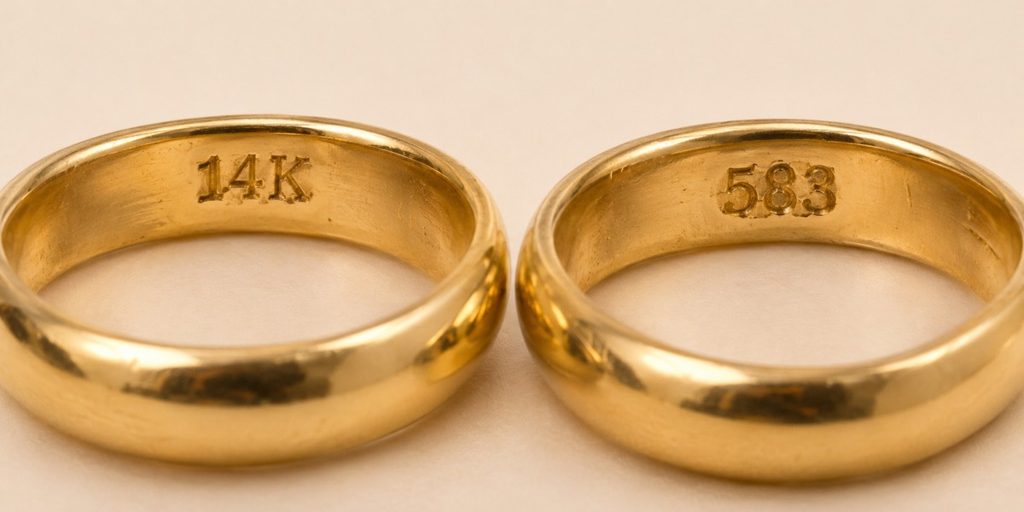
- 14K: 14 parts out of 24, or about 58.3%.
- 18K: 18 parts out of 24, or 75%.
So a 14K solid gold ring isn’t 24K, and it isn’t meant to be. Pure gold is soft enough to bend and scuff quickly on a hand that’s working all day. In Canada, a gold quality mark can only be applied to gold with a minimum quality of 9K, and you may see decimal stamps instead of karats: .416 for 10K, .583 for 14K, and .750 for 18K. If you are unsure whether a piece is solid or plated, our guide on how to test gold walks through the checks step by step.
What Gold-Filled Means
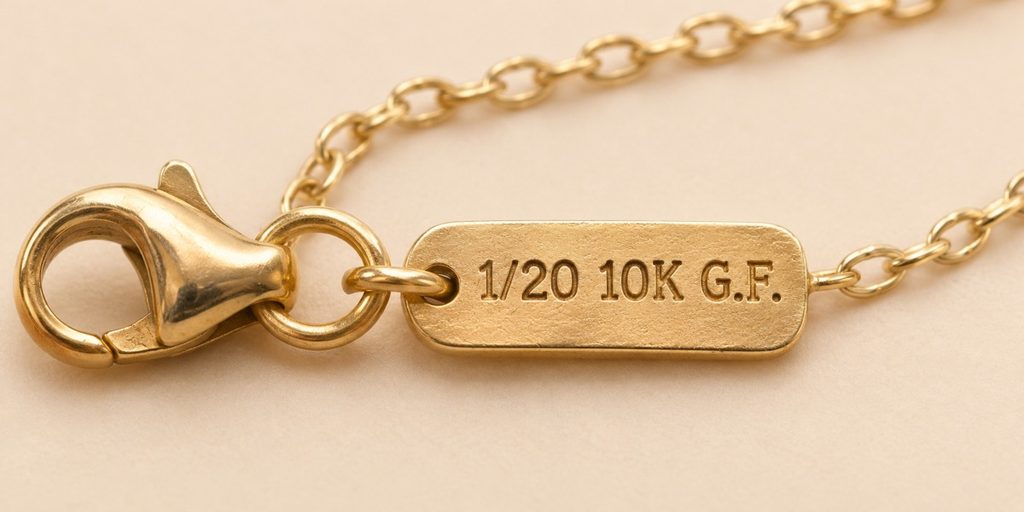
Gold-filled jewellery starts with a base metal and a sheet of gold alloy fused to it with heat, which the rules describe as brazing, soldering, or sweating. The result is a much heavier layer than plating, but the core is still another metal.
Canada sets a clear bar for the term. To be marked gold-filled, the gold must be at least 10K and make up at least 1/20 of the gross weight of the whole item. If a karat appears in the mark, the fraction must come first, so “1/20 10K G.F.” tells you the layer is 10K gold and accounts for one-twentieth of the weight. You may also see the French term doublé d’or.
Rolled gold plate is made the same way, but the gold makes up less than 1/20 of the weight. It’s marked R.G.P. or rolled gold plate, sometimes with a fraction such as 1/30. It isn’t fake, just less bonded gold, which should show up in the price.
What Gold Vermeil Means in Canada
Vermeil is gold-plated over silver, and in Canada the word has a defined meaning. Under the Precious Metals Marking Regulations, the silver must be at least .925 (sterling) and the gold plating must be at least 10K. The regulations don’t set a minimum plating thickness for vermeil. A thickness can be stated on the piece only if it’s at least 1 micrometre.
You may have read that vermeil needs 2.5 microns of gold. That number comes from United States Federal Trade Commission (FTC) guidance, which sets a 2.5-micron minimum for vermeil sold in the US. It isn’t Canadian law, so if thickness matters to you, ask a Canadian seller for the figure in writing.
The silver base is vermeil’s real advantage over ordinary plating. When the gold wears through, you see silver rather than brass or copper, and a jeweller can often clean and replate it.
What Gold-Plated Jewellery Means
Gold plating is a layer of gold deposited onto the surface of another material, most often by electroplating. The base can be almost anything: brass, copper, stainless steel, silver, or a blend. Canadian rules require the plating itself to be at least 10K gold, but they don’t set a minimum thickness for plated jewellery, and sellers aren’t allowed to make durability claims about precious metal plating. Common marks include gold plated, gold electroplate, and G.E.P.
When you’re judging a plated piece, keep three things separate:
- Colour: A yellow, rose, or white finish tells you nothing about what the piece is made of. Plating can be made to look like almost any gold.
- Karat: On plated jewellery, a “14K” or “18K” label describes only the surface layer, not the item.
- Thickness: This is what affects wear the most. Canadian marks may state it in whole micrometres if it’s at least 1 micrometre; if a listing gives no figure, ask.
How Each Type Wears with Frequent Use
How long surface gold looks new depends as much on how you wear a piece as on its label. Three things do most of the damage:
- Friction: Rings rub against keyboards, steering wheels, and each other, and bracelets drag across desks. Earrings and pendants get far less contact, so the same layer usually lasts longer there.
- Perspiration and Skin Products: Sweat, lotion, perfume, and hairspray sit against the metal every day. Chemical exposure can damage or discolour precious metals, and chlorine bleach can pit gold alloys, solid gold included.
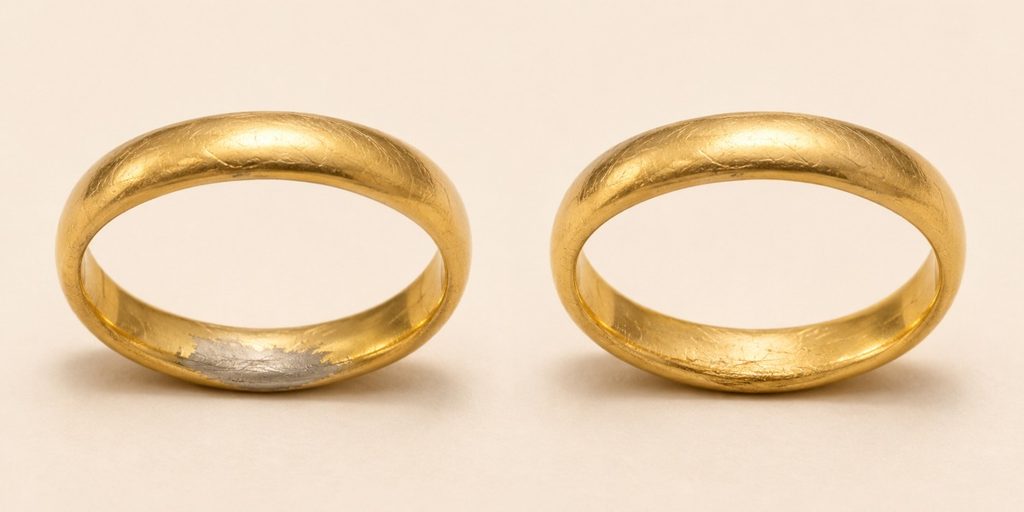
- Exposed Base Material: Once a layer thins at an edge or high point, the base starts to show. That often happens first on the underside of a ring, the corners of a clasp, or the links of a chain that rub together.
Solid gold wears too, but it wears into more gold, and a jeweller can polish or rebuild a thinned band. Gold-filled tends to outlast thin plating because there’s more gold to lose, yet no construction comes with a fixed lifespan.
Wear-through matters for sensitive skin, too, since a plated piece may feel fine until the base touches your skin. If you react to certain metals, ask what the base and the gold alloy contain; no label is an allergy guarantee.
Repair, Replating, and Care: Check the Complete Piece
Whether a piece can be repaired depends on its construction, any gemstones, and its condition, so a jeweller needs to see the whole item before quoting:
- Solid Gold: Usually the most workable. It can be resized, soldered, polished, and refinished, though worn-thin areas may need metal added.
- Gold-Filled: Repairs such as soldering a broken link may be possible, but heat and heavy polishing affect the bonded layer, and a worn-through layer can’t be rebuilt.
- Vermeil: The sterling base can often be cleaned, repaired, and replated.
- Gold-Plated: Replating can refresh the colour, while other repairs depend on the base metal and whether the work is worth the cost.
Stones change the picture. A ring with a centre stone needs its prongs, head, and band checked separately, and knowing the parts of an engagement ring makes it easier to follow a repair quote. Some gems also react badly to heat, steam, or chemicals used during repairs and replating.
Cleaning deserves the same caution. Ultrasonic cleaners can damage fracture-filled, oiled, or coated gems and can shake stones loose. Strong cleaning solutions can also harm delicate stones and surface finishes, so start with warm water, mild soap, and a soft brush, and ask a jeweller before using anything stronger.
How to Read a Listing and Choose for Your Budget
A good listing tells you what an item is made of, not just what colour it is. Before you buy, look for these details:
- Composition: Whether the whole item is gold alloy (“14K gold”) or the description says gold-filled, vermeil, or gold-plated.
- Base Metal: For any surface-gold piece, the metal underneath. Vermeil should be sterling silver; plated items can be almost anything.
- Layer Details: The weight fraction for gold-filled, the karat of the layer, and a thickness in micrometres for plating or vermeil if the seller has one.
- Quality Marks: Stamping isn’t mandatory in Canada, but any quality mark has to be accurate and generally comes with a Canadian trademark. If only part of an item is precious metal, the mark should name that part.
- Seller Disclosure and Written Terms: What’s in writing about returns, resizing, repairs, and what counts as normal wear.
Budget comes down to how the piece will be worn. Vermeil or plating suits occasional or trend-driven pieces, gold-filled generally holds up better for daily wear, and solid gold is built for jewellery meant to last decades and be repaired along the way.
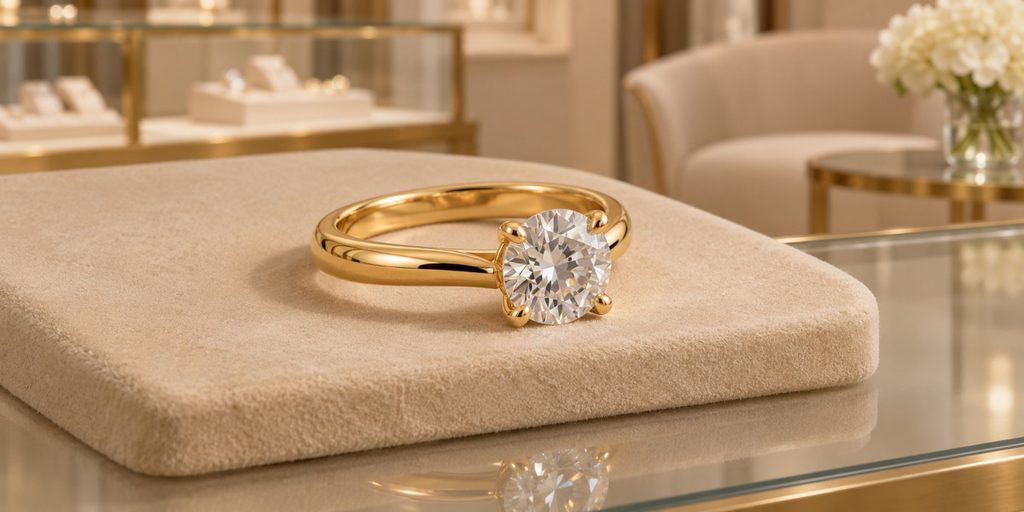
Engagement and wedding rings are the clearest example. They take constant contact, get resized, and need their settings checked, which is why fine diamond rings are typically made in solid gold or platinum. Within solid gold, karat and band design still shape the price.
Browsing gold band engagement ring styles shows how a band’s design affects the metal it needs: a wide or detailed band uses more gold than a slim one. That can move the price as much as karat does. When you compare engagement rings in Toronto, ask to see the karat stamp and get the metal described on your receipt.
Choosing Between Solid Gold, Gold-Filled, Vermeil, and Gold-Plated Jewellery
The label tells you where the gold is, and that answer decides nearly everything else: how a piece ages, what a jeweller can fix, and how much of the price is gold. Match the construction to how often you’ll wear it, and ask for details in writing whenever a listing is vague.
If you’re choosing a ring or anything you’ll wear every day, it helps to compare karats in person. You can compare solid gold rings with the Samuel Kleinberg team and leave knowing exactly what your piece is made of.
Frequently Asked Questions
1. Can a hollow ring still be solid gold?
Yes, as long as its walls are gold alloy throughout. “Hollow” describes the shape, not the metal, so a hollow band uses less gold and usually costs less, but it dents more easily and can be harder to resize or repair. Ask whether a ring is hollow before comparing prices by karat alone.
2. Does a magnetic clasp mean the entire necklace is not solid gold?
No. Clasps, springs, and other small parts are often made from different materials than the chain, and a magnetic clasp contains a magnet by design. A household magnet test can’t confirm what the rest of the necklace is made of either, so check the quality mark, the trademark, and the seller’s written description, or have a jeweller test it.
3. Can a worn gold-filled piece simply be restored by ordinary gold plating?
Plating can bring back the gold colour, but it adds a new deposited layer rather than recreating the bonded sheet that made the piece gold-filled. The refreshed surface will wear like plating, not like the original layer. A jeweller can assess the wear and tell you whether plating, repair, or neither makes sense.