

Shopping for an engagement ring? You’ve probably noticed that two diamonds with the same carat weight and similar grades can carry very different price tags. If you’re comparing synthetic diamond vs. real diamond price, a lab-grown diamond is usually priced well below a comparable natural diamond, even when the two look the same on paper and in the hand.
First, a quick word on terms. “Synthetic diamond” is simply another name for a laboratory-grown diamond. Despite what the comparison might suggest, both lab-grown and natural diamonds are real diamonds, with the same carbon crystal structure and chemical makeup. A synthetic diamond is not cubic zirconia, moissanite, or any other diamond look-alike. What separates the two is origin, and origin has a big say in price.
Below, we walk you through what drives the difference (rarity, production, supply, demand, and resale expectations) and how grading, carat weight, cut, colour, clarity, and shape influence the price of both, so you can compare stones like for like and spend with confidence.
Synthetic Diamond vs. Real Diamond Price: Quick Comparison
Before we get into the details, here’s how the two stack up side by side.
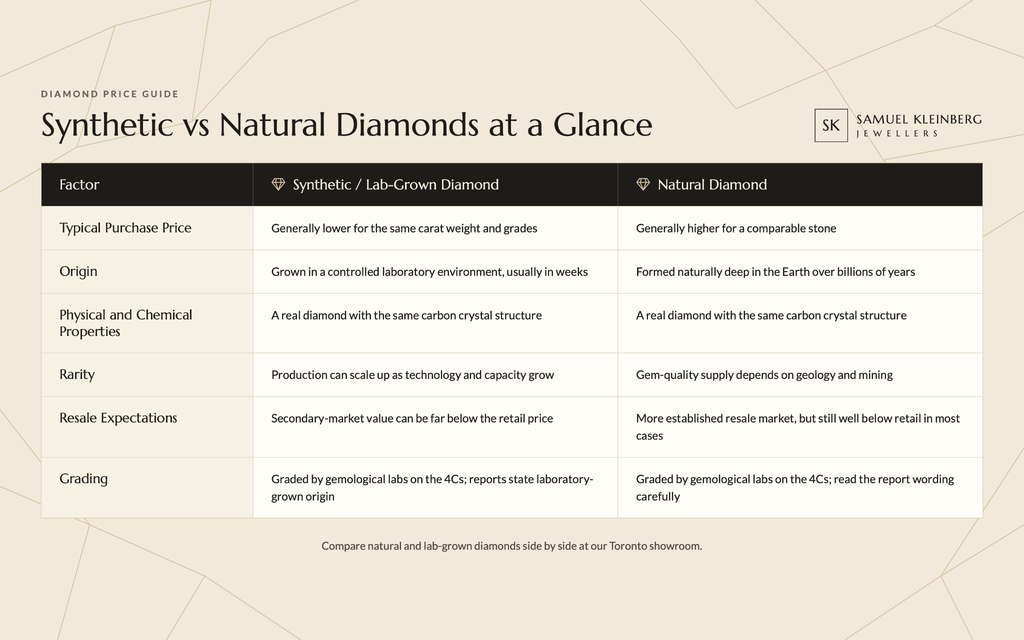
Why Are Synthetic Diamonds Less Expensive Than Natural Diamonds?
It comes down to rarity. A natural diamond needs extreme heat, pressure, and an enormous amount of time to form, and then it has to be found, mined, sorted, cut, and brought to market. Gem-quality rough is finite, and that scarcity is built into every natural stone’s price.
A lab-grown diamond removes the geological lottery. Producers recreate those conditions with high-pressure, high-temperature (HPHT) presses or chemical vapour deposition (CVD) reactors, and they can grow more stones whenever demand calls for it. As technology improves, factories expand, and more producers compete, lab-grown prices have faced steady downward pressure.
Natural diamond pricing follows a different set of rules: scarcity, the cost of mining and distribution, and long-established consumer demand. If you want a deeper look at how the two compare beyond price, our guide to lab-grown vs. natural diamonds covers origin, appearance, and buyer priorities.
One thing a lower price does not mean: that a lab-grown stone is fake or chemically inferior. You’re paying less for a different origin story, not for less diamond.
How Much Cheaper Are Synthetic Diamonds?
When people search for the synthetic diamond vs. real diamond price gap, they usually want one number. The honest answer is that the gap moves with the market, the retailer, the carat weight, the shape, and the grades.
That said, the direction is clear. In 2025, CBC News reported a Toronto example in which a 2-carat natural diamond engagement ring was priced at around $35,000, while a lab-grown stone of the same clarity and colour came in at roughly $3,500. Natural prices have moved too: Rapaport’s widely used price index shows that average natural diamond prices have fallen considerably since their 2022 peak.
So treat any percentage as a snapshot, not a rule. The comparison that counts is two specific stones with similar specs and grading documentation, priced on the same day.
What Determines the Price of Both Natural and Lab-Grown Diamonds?
Origin sets the price range, but the 4Cs of diamond quality and a few other traits decide where a stone lands within it, whichever of the diamond types you’re considering.
Carat Weight
Larger diamonds cost more, and prices tend to step up noticeably at popular milestones like 1.00 carat. Always compare exact measurements in millimetres too. Two stones of equal weight can face up differently if one carries more of its weight in depth.
Cut
Cut has the most direct effect on brightness, fire, and sparkle. A well-cut 0.90-carat diamond can look livelier, and sometimes bigger, than a heavier stone with weak proportions.
Colour
Higher colour grades command higher prices. Once a diamond is set, though, the difference between neighbouring grades is often hard to see, especially in yellow or rose gold.
Clarity
Higher clarity grades cost more, even when the difference is invisible without magnification. Aim for a stone that looks clean to the eye with no durability concerns, rather than paying for the top grade on principle.
Shape and Proportions
Round brilliants usually price differently from fancy shapes because of strong demand and more rough lost during cutting. Shapes like ovals and pears can also look larger face-up at the same carat weight.
How Carat Weight Changes the Price Gap
The bigger the diamond, the bigger the dollar difference tends to be. Natural diamond prices climb steeply as size increases, because large, high-quality rough is rare. Lab-grown production doesn’t face the same scarcity, so its prices rise more gently.
In practice, the savings on a 1-carat stone might cover the setting. At 2 carats, the gap can be large enough to change what you can afford entirely. Our breakdown of 2-carat lab-grown diamond prices shows how that plays out by grade.
That’s why a larger lab-grown diamond often fits a budget that would only buy a smaller natural diamond of similar quality. The real question is what matters most to you: size, natural origin, rarity, or budget.
Natural vs. Lab-Grown Diamond Price Per Carat
Price per carat is the total price of a diamond divided by its exact carat weight. A 1.20-carat diamond at $6,000 works out to $5,000 per carat.
It’s a handy tool, but only when you compare stones of similar quality and the same origin. Natural and lab-grown diamonds sit in different markets, so comparing one against the other on price per carat alone tells you very little.
Watch the milestones, too. Prices often jump at 0.50, 1.00, 1.50, and 2.00 carats, so a 0.95-carat stone can be noticeably cheaper than a 1.00-carat one that looks almost the same. Our guide to diamond price per carat explains how to use these thresholds to your advantage.
Do Synthetic Diamonds Have the Same Quality Grades as Natural Diamonds?
Yes. Both are assessed for cut, colour, clarity, and carat weight. The Gemological Institute of America (GIA), for example, issues a dedicated laboratory-grown diamond report that uses the same colour and clarity scales it applies to natural stones, and it laser-inscribes those diamonds with the report number and the words “laboratory-grown.”
Still, read the report itself, not just a summary at the counter. Check which lab issued it and how it states the diamond’s origin. Wording changes over time: GIA stopped using the term “synthetic” on its lab-grown reports in 2019. In Canada, the Canadian Jewellers Association (CJA) also expects “lab-grown,” “lab-created,” or “synthetic” to appear right beside the word “diamond” whenever a lab-grown stone is sold.
Finally, match the paperwork to the stone. A laser inscription on the girdle lets a jeweller confirm the diamond in front of you is the one on the report. Our guide on how to identify lab-grown diamonds explains why visual inspection alone isn’t enough.
Does a Lower Price Mean a Lab-Grown Diamond Is Lower Quality?
No. Price and quality are two separate things. A lab-grown diamond can have an excellent cut, top colour, and very high clarity, yet still cost far less than a natural stone with the same grades.
The lower price reflects origin, rarity, supply, and market dynamics, not whether the stone is a diamond. So judge each diamond on how it looks and how it’s graded, then weigh origin as a separate decision.
Natural vs. Synthetic Diamond Resale Value
Here’s the truth: neither natural nor lab-grown diamonds should be bought with a guaranteed resale return in mind. A diamond is something you wear and treasure, not a savings account.
Natural diamonds have a more established secondary market, so they generally recover more of their price. Even so, natural prices have dropped significantly in recent years. Lab-grown resale values are harder to predict, because falling production costs keep pushing new-stone prices down.
It also helps to know which number you’re looking at:
- Retail Price: What you pay in the store.
- Appraisal Value: Usually a replacement-cost estimate for insurance, often above what you paid.
- Trade-In Value: Credit a retailer may offer toward an upgrade, under its own policy.
- Resale Value: What a buyer will actually pay you, typically the lowest of the four.
Which Is Better Value: Synthetic or Natural Diamond?
The better value is the one that matches your priorities.
- Choose Lab-Grown If: You want a larger stone, higher grades, or a lower upfront cost for the same look.
- Choose Natural If: You value geological origin, rarity, tradition, or the established natural-diamond market.
Plenty of buyers change their minds once both are in front of them. The surest way to decide is to see both side by side and understand the paperwork before you commit.
How to Compare Prices Properly Before Buying
A price only means something when you know exactly what it’s buying. Use this checklist before you commit:
- Match the Specs: Compare diamonds with similar carat weight, cut, colour, clarity, and shape.
- Check the Measurements: Look at exact dimensions and proportions, not just carat weight.
- Confirm the Origin: Verify whether the stone is natural or lab-grown, and check that the grading report matches it. Knowing how to tell if a diamond is real helps you confirm exactly what you’re comparing.
- Run Both Numbers: Compare the total price as well as the price per carat.
- Change the Lighting: View each diamond in daylight, store lighting, and softer light whenever possible.
- Ask About Policies: Find out whether trade-in, upgrade, return, or warranty terms apply, and whether they differ for natural and lab-grown stones.
Seeing stones in person makes all the difference. At Samuel Kleinberg, we carry natural and lab-grown loose diamonds at our Toronto showroom and have helped clients choose with confidence since 1968. Compare stones side by side with us, read the reports together, and see how each looks in the setting you love, from our diamond engagement rings, everyday diamond rings, or a sparkling band from our diamond eternity rings collection.
Ready to see the difference for yourself? Book an appointment, and we’ll help you find the right diamond for your style and budget.
Frequently Asked Questions
1. Why Can Two Lab-Grown Diamonds With the Same Carat Weight Have Different Prices?
Carat weight is only one factor. Cut, colour, clarity, shape, proportions, grading documentation, and each retailer’s pricing can all create a difference, even when two stones weigh the same.
2. Do Lab-Grown Diamond Prices Change Faster Than Natural Diamond Prices?
They can. Lab-grown pricing is more sensitive to manufacturing capacity, technology improvements, and supply growth. Natural diamond pricing follows a different supply-and-demand structure tied to mining and rarity.
3. Is a Synthetic Diamond the Same as Cubic Zirconia?
No. A synthetic or lab-grown diamond is a real diamond grown in a laboratory. Cubic zirconia is a different material altogether, used as a diamond simulant.
4. Can a Jeweller Tell Whether a Diamond Is Natural or Lab-Grown Just by Looking at It?
Not reliably. The two can look identical, even under a loupe. Specialized gemological equipment and a grading report are usually needed to confirm origin.
5. Does Insurance Value Equal Resale Value?
No. An insurance appraisal estimates what it would cost to replace your piece for coverage purposes. It doesn’t guarantee what the diamond could sell for on the secondary market.