
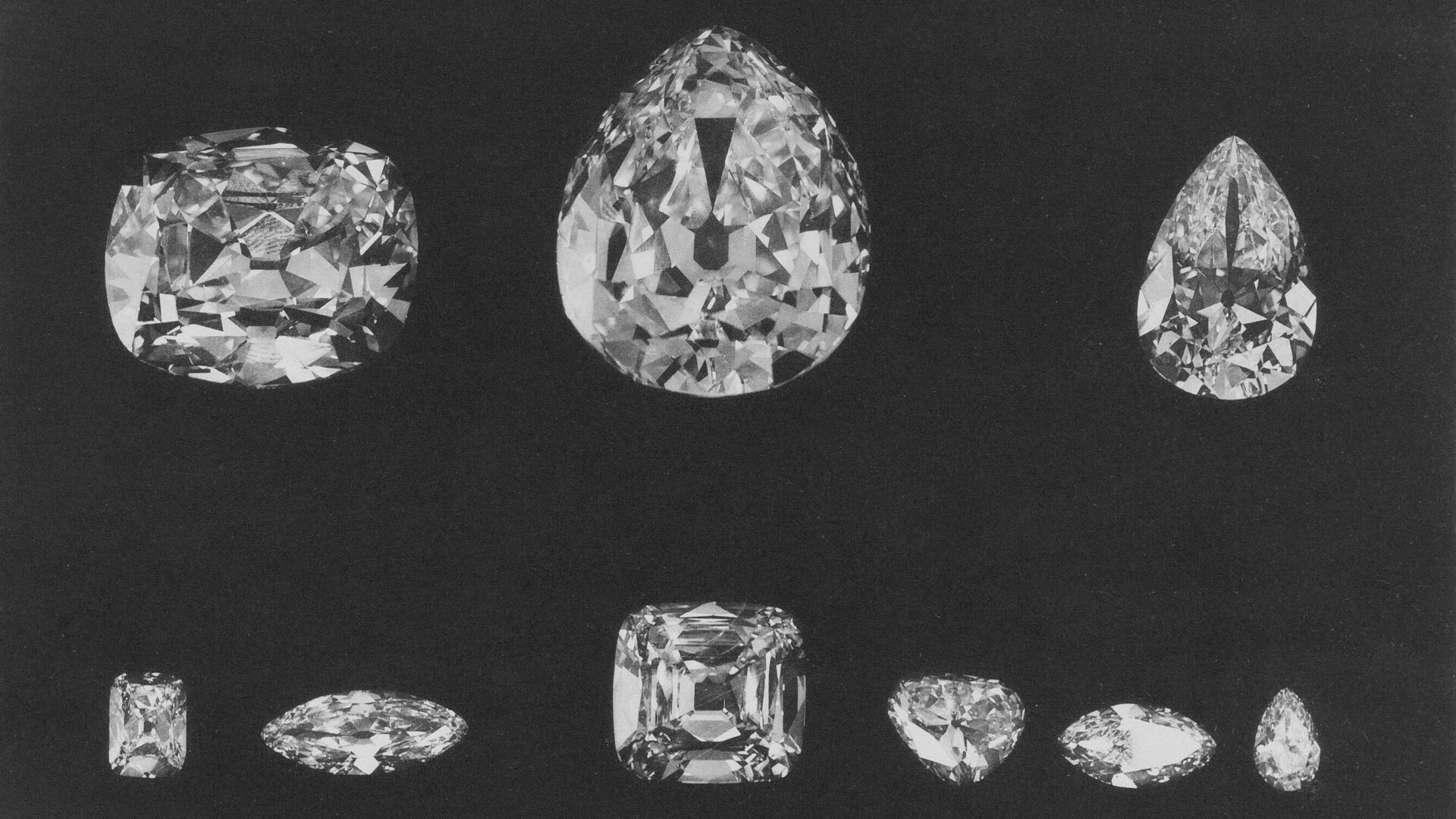
When people think about diamonds, they often focus on carat weight or clarity. However, one of the most important factors that determines how beautiful a diamond appears is its cut. The cut of a diamond directly influences how light travels through the stone, which affects its sparkle, brilliance, and overall visual impact.
Understanding diamond cuts can help buyers make confident decisions when choosing engagement rings, wedding bands, or fine jewellery pieces. A well-cut diamond reflects light in a way that creates extraordinary brilliance, while a poorly cut diamond may appear dull even if it has excellent clarity or color.
This guide explores the different types of diamond cuts and helps you understand how to determine the best cut of diamond for your preferences.
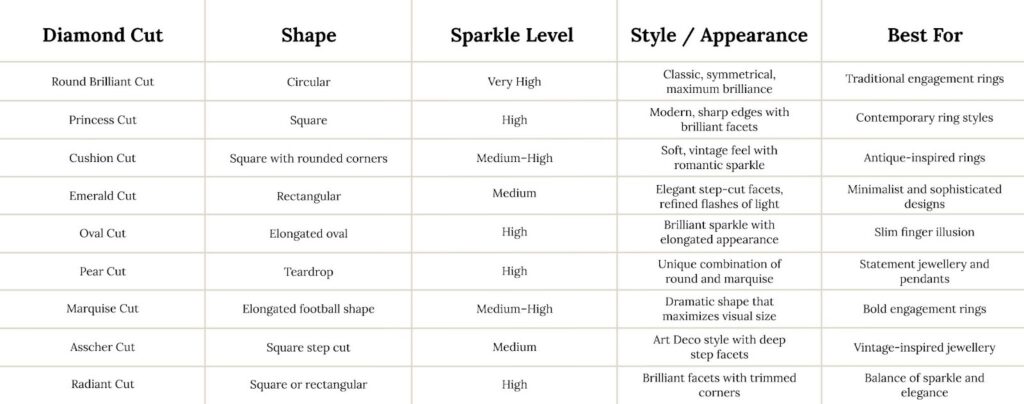
Understanding the Diamond Cuts Chart
A cut of diamonds chart is a visual and technical roadmap used by jewelers and buyers to evaluate how well a diamond has been fashioned from its rough state. It isn’t just about the shape (round vs. square); it’s about the physics of light.
What the Chart Tracks
Most professional charts compare three critical factors:
- Proportions: The relationship between the table size, crown angle, and pavilion depth.
- Symmetry: How precisely the facets align.
- Polish: The smoothness of the diamond’s surface.
The Grading Scale
The Gemological Institute of America (GIA) grades diamond cuts on a scale that you will see on almost any reputable chart:
- Excellent: Maximum light return; the diamond reflects nearly all light entering it.
- Very Good: Exceptional brilliance, though slightly more light escapes through the sides than an “Excellent” grade.
- Good/Fair: Noticeable light leakage; the diamond may appear “dark” in the center.
- Poor: Most light escapes through the bottom, leaving the stone looking dull or “glassy.”
Why Diamond Cut Charts Are Useful
A diamond-cut chart simplifies complex gemological information into a format that is easy for buyers to understand. By comparing shapes and proportions side-by-side, shoppers can see which cuts produce more brilliance and which cuts emphasize elegance or size.
Charts often show:
- Relative sparkle levels
- Typical proportions for each cut
- Light reflection patterns
- Overall visual style
This makes it easier to narrow down the different types of diamond cuts that match your personal taste.
Diamond Cut Grades
Independent gemological laboratories evaluate a diamond’s cut quality. Diamonds are typically graded using the following scale:
Excellent
Maximum brilliance and optimal proportions. Diamonds graded Excellent reflect nearly all light entering the stone.
Very Good
Slightly less perfect proportions, but still strong brilliance and sparkle.
Good
Reasonable light reflection with acceptable proportions.
Fair
Noticeable loss of sparkle due to poor light performance.
Poor
Light escapes from the sides or bottom of the diamond, resulting in a dull appearance.
Among the 4Cs of diamonds (cut, color, clarity, carat), many experts consider cut the most important because it determines how well the diamond performs visually.
Different Types of Diamond Cuts
There are many different types of diamond cuts, each offering a unique appearance and style. While the round brilliant remains the most popular, other cuts have become increasingly popular for engagement rings and custom jewellery.
Below are some of the most well-known diamond cuts.
Round Brilliant Cut
The round brilliant cut is the most famous and widely used diamond cut in the world. It typically features 57 or 58 facets designed specifically to maximize brilliance and fire.
This cut was perfected in the early 20th century using mathematical models that optimize how light enters and exits the diamond.
Key characteristics
- Exceptional sparkle and brilliance
- Perfectly symmetrical shape
- Works well with nearly all ring settings
Because of its light performance, the round brilliant is often considered the best cut of diamond for sparkle.
Princess Cut
The princess cut is a square-shaped diamond with pointed corners and brilliant-style facets. It became popular in the 1970s and is now one of the most sought-after modern diamond shapes.
Key characteristics
- Square or slightly rectangular shape
- Sharp corners and strong geometry
- High brilliance similar to round diamonds
Princess cuts are especially popular in contemporary engagement rings and halo settings.
Cushion Cut
The cushion cut combines a square or rectangular shape with rounded corners, creating a soft pillow-like appearance.
This cut has existed for over 200 years and was especially popular during the 19th century.
Key characteristics
- Rounded corners and larger facets
- Soft, romantic sparkle
- Vintage aesthetic
Cushion cuts are often chosen for antique-inspired engagement rings.
Emerald Cut
The emerald cut is distinguished by its rectangular shape and graceful step-cut facets. Instead of intense sparkle, emerald cuts emphasize clarity and refined flashes of light.
Key characteristics
- Long rectangular shape
- Step-cut facets
- Large open table
This cut accentuates the diamond’s clarity while producing a classy, subtle appearance.
Oval Cut
In essence, the oval cut is a longer form of the round brilliant cut. It maintains excellent brilliance while offering a more distinctive shape.
Key characteristics
- Elongated round shape
- Brilliant facet pattern
- Creates the illusion of longer fingers
Oval diamonds are increasingly popular for engagement rings because they combine sparkle with a unique silhouette.
Pear Cut
The pear cut, sometimes called a teardrop cut, combines the brilliance of a round diamond with a pointed tip on one side.
Key characteristics
- Teardrop shape
- Unique and elegant appearance
- Often used in pendants and statement rings
Pear-shaped diamonds can create a dramatic and distinctive look.
Marquise Cut
The marquise cut has pointy ends and an extended form. Legend suggests it was commissioned by King Louis XV of France to resemble the smile of the Marquise de Pompadour.
Key characteristics
- Football-like shape
- Maximizes visible size
- Elegant and dramatic
Because of its elongated shape, the marquise cut can make a diamond appear larger than its actual carat weight.
Asscher Cut
The Asscher cut is a square step-cut diamond similar to the emerald cut but deeper and more symmetrical.
Developed in 1902, it became popular during the Art Deco era.
Key characteristics
- Square shape with step facets
- Deep pavilion
- Vintage geometric look
The Asscher cut produces a mesmerizing “hall of mirrors” effect.
Radiant Cut
The radiant cut combines the rectangular shape of an emerald cut with the brilliance of a round diamond.
Key characteristics
- Rectangular or square shape
- Brilliant facet pattern
- Excellent sparkle
Radiant cuts are ideal for buyers who want both brilliance and a distinctive shape.
Best Cut of Diamond: What It Really Means
When discussing the best cut of diamond, the answer depends on what qualities matter most to the buyer.
Generally, the best cut refers to the following:
- Maximum brilliance
- Strong fire (colored light dispersion)
- Balanced symmetry
- Ideal proportions
Among all cuts, the round brilliant cut is widely considered the best for sparkle because its facet arrangement is optimized for light reflection.
However, the best cut for an individual may also depend on style preferences.
For example:
- Someone seeking a vintage look may prefer cushion or Asscher cuts
- A minimalist style might favour emerald cuts
- Modern engagement rings often feature princess or oval cuts
We recommend choosing a cut that complements both the ring setting and the wearer’s personal style. For many couples, the ideal diamond is not just the most brilliant one but the one that feels most meaningful.
How to Use a Diamond Cuts Chart to Choose Your Diamond
A diamond cut chart can help buyers evaluate options before selecting a diamond. Here is a simple approach to using one.
Step 1: Identify the Diamond Shape
Start by deciding whether you prefer a round, square, rectangular, or elongated diamond.
Step 2: Compare Proportions
Charts often include recommended proportions for each cut type, such as table percentage and depth percentage. These measurements affect brilliance.
Step 3: Evaluate Light Performance
Some charts include diagrams showing how light reflects through different cuts. Diamonds with stronger light return typically appear brighter.
Step 4: Match Cut With Lifestyle
Certain shapes may be more practical depending on everyday wear. For example:
- Rounded shapes are more durable
- Sharp corners require protective settings
Matching Diamond Cut With Ring Style
The combination of diamond cut and ring setting can dramatically change the overall appearance of a piece. Some classic combinations include:
Round Cut with Solitaire Setting
This timeless pairing emphasizes brilliance and simplicity.
Princess Cut with Halo Setting
The halo enhances the square geometry and increases perceived size.
Emerald or Asscher Cuts with Vintage Settings
Step-cut diamonds pair beautifully with Art Deco-inspired designs.
Oval or Pear Cuts with Modern Settings
These shapes create elegant and contemporary engagement rings.
Choosing the right combination of cut and setting allows the diamond’s beauty to stand out while complementing the wearer’s personal style.
A diamond’s cut plays a crucial role in determining how beautiful and brilliant it appears. While carat weight and clarity matter, the cut controls how effectively a diamond interacts with light.
Find Diamond Jewellery Pieces at Our Toronto Store
View our stunning selection of exquisite jewellery with sparkling diamonds. Samuel Kleinberg Jewellers offers a wide range of designs, including bridal and wedding pieces as well as jewellery perfect for daily wear. Whether you are choosing an engagement ring or a timeless gift, our team is here to help you find the perfect diamond.
Visit samuelkleinberg.com or stop by our Toronto store to discover exquisite diamond jewellery designed to last a lifetime.