
A ring should feel secure, slide over the knuckle comfortably, and sit without pinching. Accurate ring measurement matters because a ring that is too loose may spin or fall off, while one that is too tight can be uncomfortable and difficult to remove.
You can check your size at home with a ring finger sizer, by measuring your finger, or by checking the inside diameter of a ring that already fits. For engagement rings, wedding bands, wide bands, or custom designs, Samuel Kleinberg Jewellers can provide professional sizing for a more accurate fit.
Quick answer: A reusable ring sizer or a correctly measured ring is usually more reliable than string or paper. Professional finger-sizing gauges provide the greatest accuracy.
Why Accurate Ring Measurement Matters
When a ring is fitted correctly, it should feel snug without applying pressure. Ideally, it should:
- Slide over the knuckle with gentle resistance.
- Remain upright instead of turning freely.
- Sit comfortably at the base of the finger.
- Come off without excessive pulling.
- Leave no deep or painful indentation.
The correct size is particularly important for rings containing pavé, channel-set diamonds, stones around the full band, or complex design details. These styles may be harder or more costly to resize after they have been made.
Ring width also changes how a ring feels. A size that is comfortable in a delicate engagement ring may feel tighter in a wide wedding band. This is why the final size should be selected with the exact ring design in mind rather than based only on a number.
How to Check Your Ring Size at Home
There are three practical ways to estimate your size at home. Whichever method you choose, measure the exact finger on the hand where the ring will be worn.
Do not assume that the same finger on your other hand will be identical. Finger sizes can differ between the dominant and non-dominant hand, and GIA notes that this difference may sometimes be approximately half a size.
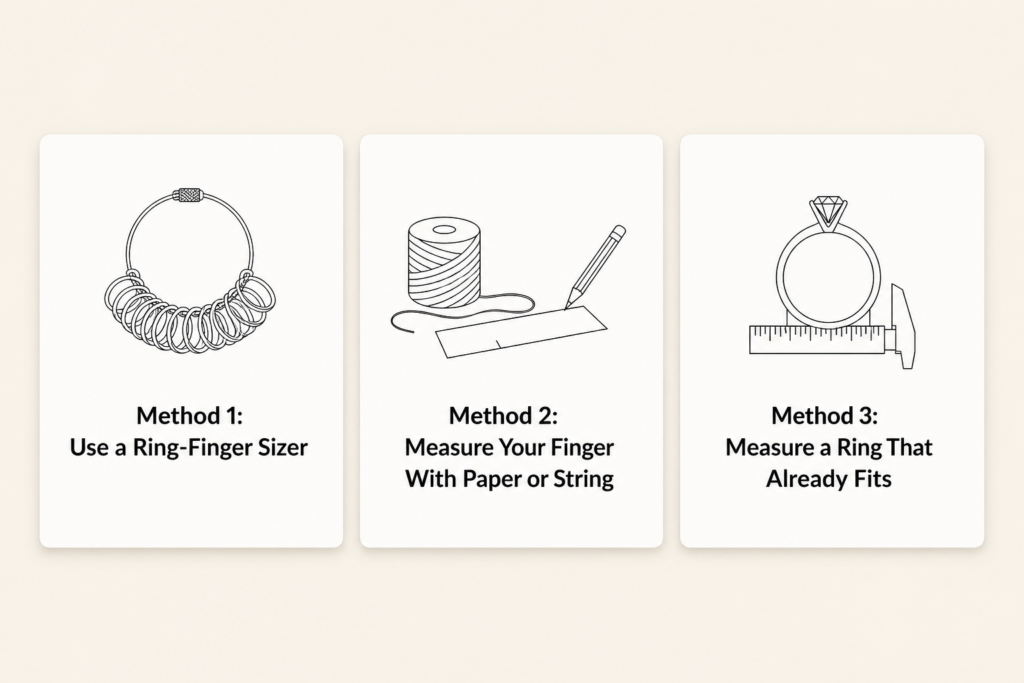
Method 1: Use a Ring-Finger Sizer
A ring-finger sizer is one of the simplest options for measuring at home. It may come as a set of plastic rings or as an adjustable strip marked with ring sizes.
To use it:
- Place the sizer around the intended finger.
- Adjust it until it feels comfortable at the base.
- Slide it over the knuckle.
- Check that it does not slip off too easily.
- Repeat the process two or three times.
The sizer should feel snug, but it should not pinch your skin. When you remove it, you should feel slight resistance at the knuckle.
When using a printable version, confirm that the guide is printed at 100% scale. Resizing the page during printing can change the measurements and produce an incorrect result.
Method 2: Use Paper or String to Measure Your Finger
Paper or string can provide a quick estimate when you do not have a measuring tape or sizing tool.
Follow these steps:
- Cut a narrow strip of paper or choose a piece of non-stretchable string.
- Gently encircle the base of the finger with it.
- Mark the exact point where the ends meet.
- Lay the material flat.
- Measure the marked length in millimetres.
- Compare the result with a ring finger size chart.
Do not pull the material too tightly. It should reflect how you want the ring to sit, while still allowing enough room to pass over the knuckle.
This method should be treated as an estimate rather than a final measurement. String can stretch, paper can bend or curl, and neither method fully accounts for the shape of the knuckle. GIA therefore recommends using more accurate sizing tools for an important or valuable ring.
Accuracy check: Repeat the measurement three times. A difference of even one or two millimetres could place you near another ring size.
Method 3: Measure a Ring that Already Fits
Measuring an existing ring can be a useful option, particularly when purchasing a gift or planning a surprise.
Choose a ring that:
- Fits comfortably now.
- Is worn on the correct finger.
- Is normally worn on the correct hand.
- Has a round, undamaged interior.
Place the ring on a flat surface and measure straight across the inside centre. Measure from one inner edge to the opposite inner edge, without including the metal of the band.
Record the inside diameter in millimetres and compare it with a reliable sizing chart for rings. Tiffany and Birks both recommend measuring the interior diameter of an existing, well-fitting ring and matching it with the closest chart measurement.
For the best result, use a ruler with clear millimetre markings or a digital calliper. If the ring is bent, oval, unusually wide, or no longer perfectly round, the measurement may not be reliable.
How to Read a Ring Finger Size Chart
A ring finger size chart may include two different measurements:
- Inside diameter is the straight-line distance across the interior of a ring.
- Finger circumference is the distance around the finger where the ring will sit.
In Canada, many jewellers use standard US numerical ring sizes. Maison Birks, for example, identifies US ring sizing as its standard and provides millimetre measurements for comparison.
Common Ring Size Chart
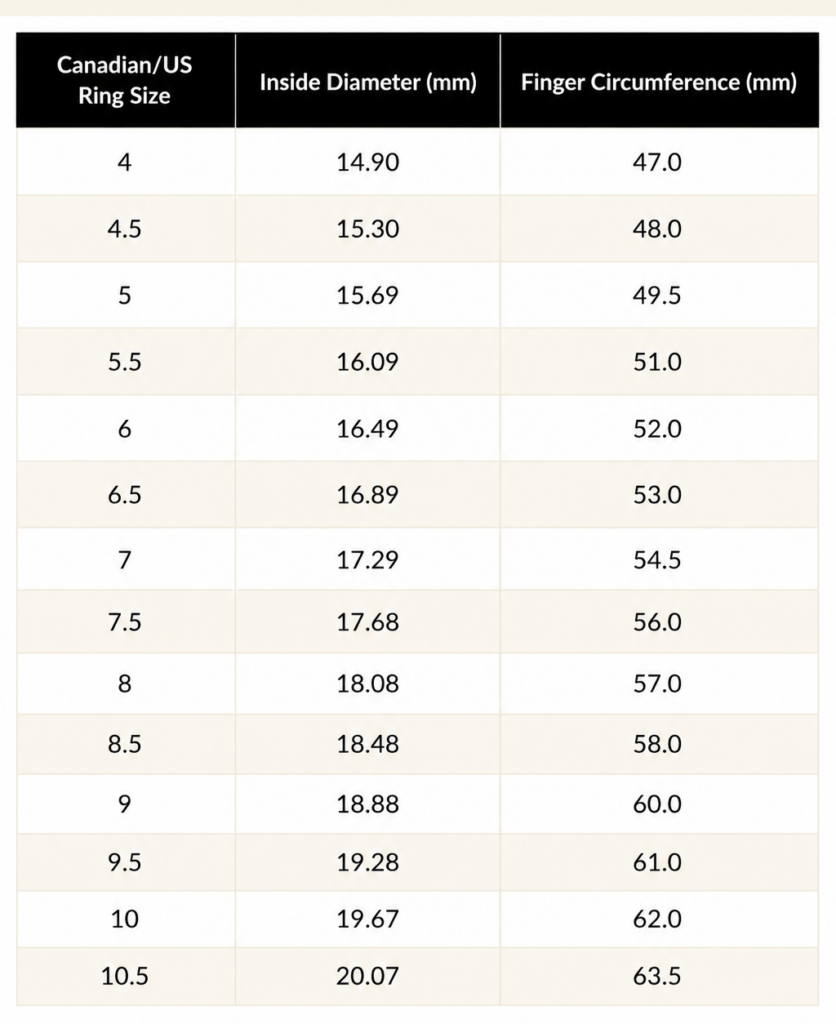
These figures are based on the current Maison Birks sizing guide. Small differences may appear between charts because measurements are rounded and individual ring designs fit differently.
When your result falls between two sizes, the larger size may be more comfortable, especially if the ring is wide or must pass over a prominent knuckle. However, the ring style should be considered before making the final decision.
What Time Is Ideal for Measuring Your Finger?
Throughout the day, the size of your fingers changes. Temperature, humidity, activity, travel, and temporary swelling may affect the measurement.
For a more dependable result:
- Measure near the end of the day.
- Make sure your hands are at a normal, comfortable temperature.
- Avoid measuring immediately after exercise.
- Do not measure when your hands feel unusually swollen.
- Avoid measuring when your fingers are very cold.
- Take two or three measurements.
- Use the same finger and hand each time.
Fingers tend to shrink in cold conditions and expand in warmer conditions. GIA also notes that humidity, altitude, and the time of day can affect finger size.
Try This Quick Consistency Test
Measure your finger once in the afternoon and again in the evening.
- If both results match, you probably have a useful estimate.
- If they differ slightly, consider the larger measurement.
- If they differ significantly, arrange professional sizing before ordering.
Factors That Can Affect Ring Size
Even a careful home measurement may need to be adjusted because of the following factors.
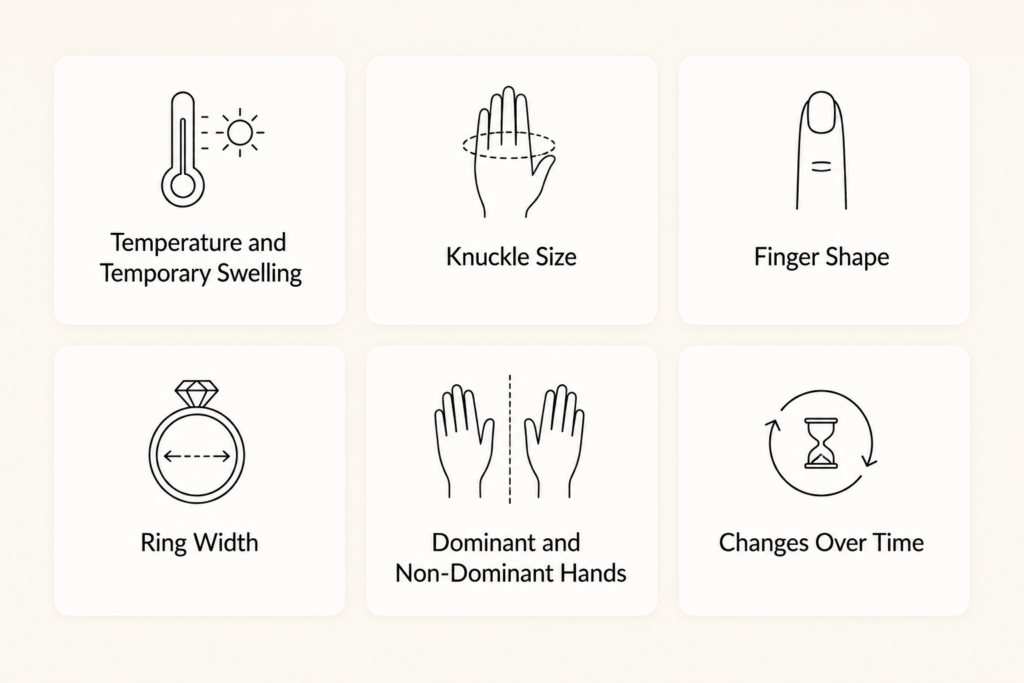
Temperature and Temporary Swelling
Heat, physical activity, salty foods, travel, and other temporary factors can cause fingers to swell. Cold weather may make them feel noticeably smaller.
Knuckle Size
Some people’s knuckles are wider than their finger bases. The ring must be large enough to pass over the knuckle but secure enough not to rotate constantly once it is in place.
Finger Shape
A finger may taper toward the base, remain relatively straight, or be wider around the knuckle. These differences can affect how securely the ring sits.
Ring Width
A wide band covers more of the finger and usually feels tighter than a narrow band in the same numerical size. Bridal sets with a combined width greater than approximately four or five millimetres may require additional sizing consideration.
Dominant and Non-Dominant Hands
The same finger may not be the same size on both hands. Always measure the exact hand on which the ring will be worn.
Changes Over Time
Weight changes, aging, pregnancy, health conditions, medication, climate, and lifestyle may affect finger size. A ring that fitted well several years ago may no longer provide an accurate reference.
Should Wider Rings Be Sized Differently?
A wide wedding band, bold fashion ring, or multi-ring stack may feel tighter than a slim solitaire because more metal touches the finger.
As a result, some wider designs may require a slightly larger size. However, there is no single adjustment that applies to every ring or every person. The interior shape, band width, ring profile, knuckle size, and number of stacked rings all influence the fit.
Before confirming the size, ask:
- Is the ring wider than the ring used for comparison?
- Will it be worn alone or beside other rings?
- Does it have a flat or rounded interior?
- Can the design be resized later?
- Does the finger have a prominent knuckle?
A professional fitting with a sizing gauge that closely matches the width of the chosen ring provides a more realistic result.
At-Home Ring Sizing vs. Professional Sizing
At-home measurements are helpful when browsing designs, planning a budget, or narrowing down your likely size. They are especially convenient when you need an initial estimate before an appointment.
Professional sizing is recommended when:
- Choosing an engagement ring.
- Ordering a wedding band.
- Creating a custom design.
- Purchasing a wide or unusually shaped ring.
- Selecting an eternity or diamond-set band.
- Your measurements fall between sizes.
- Your knuckle is significantly wider than the base of your finger.
- The ring will be difficult to resize.
A jeweller can use finger-sizing gauges to compare different sizes and band widths. GIA describes these gauges as the most accurate method because they allow the wearer to test how the ring passes over the knuckle and sits on the finger.
Samuel Kleinberg Jewellers offer personalized consultations for engagement rings, wedding bands, custom work, and other fine jewellery needs. A professional measurement can be considered alongside the ring’s width, setting, design, and intended use.
What to Do When Buying a Ring as a Surprise
Finding the correct size discreetly can be challenging, but there are safer approaches than guessing based on someone’s height, build, or appearance.
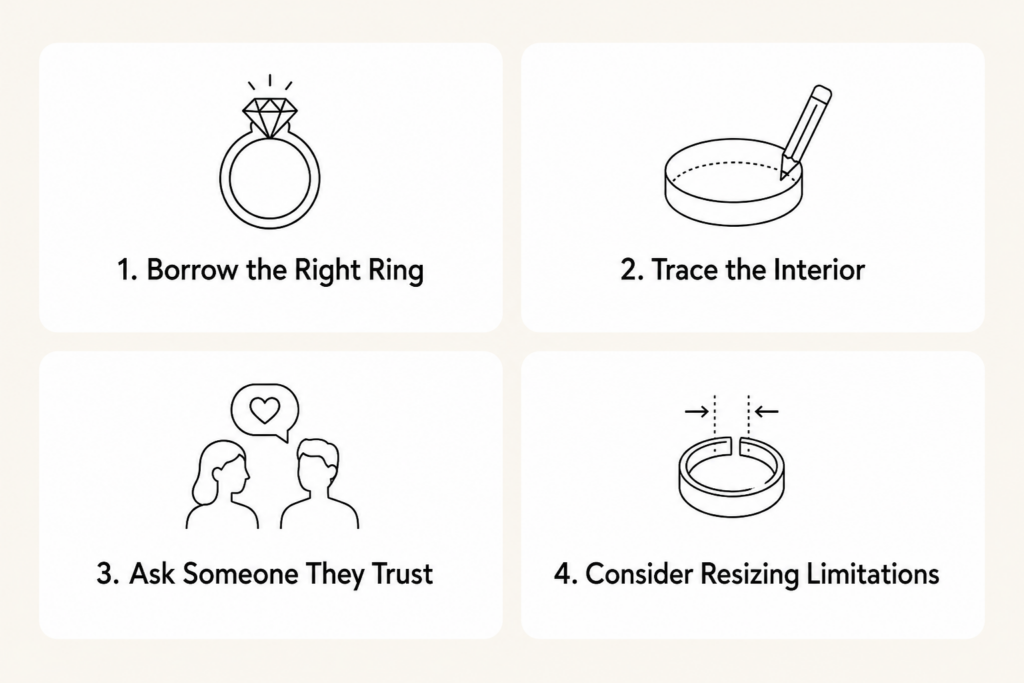
Borrow the Right Ring
Temporarily borrow a ring they wear on the intended finger. Make sure you know whether it is worn on the right or left hand.
You can bring it to a jeweller or measure its interior diameter at home.
Trace the Interior
Place the ring on paper and carefully trace the inside circle with a sharp pencil. A jeweller may use the tracing to estimate the size. GIA recommends this as one possible method when the original ring cannot be taken to the store.
Ask Someone They Trust
A close friend or family member may already know the ring size or may be able to find out without revealing the surprise.
Consider Resizing Limitations
Some rings can be resized, but the setting and construction matter. Pavé bands, channel-set designs, eternity rings, and rings with detailed metalwork may be more complicated to alter. Confirm the available options before selecting a size based on an estimate.
Final Ring-Size Checklist
Before placing an order, confirm that you have:
- Measured the correct finger.
- Measured the correct hand.
- Used millimetres rather than estimating.
- Checked the fit over the knuckle.
- Repeated the measurement.
- Consider the width of the chosen ring.
- Compared the result with a current chart.
- Asked whether the design can be resized.
- Arranged professional sizing when accuracy is essential.
Get the Right Ring Fit With Samuel Kleinberg Jewellers
A careful home measurement can help you begin your search with more confidence, but the number on a chart is only one part of finding the right fit. Ring width, finger shape, knuckle size, setting style, and everyday comfort should all be considered.
Samuel Kleinberg Jewellers can provide professional guidance when selecting an engagement ring, wedding band, or custom piece. Since 1968, the Toronto jewellery store has helped clients explore fine jewellery and personalized designs, with engagement rings, wedding bands, custom designs, and appraisal appointments available.
Contact us to confirm your ring size and choose a ring designed to feel as comfortable as it looks.
Frequently Asked Questions (FAQs)
- How can I determine the size of my ring at home?
Use a ring finger sizer, wrap paper around your finger, or measure the inside diameter of a ring that already fits.
- When should I measure my finger?
Measure near the end of the day when your fingers are at a normal temperature and slightly larger.
- What if my measurement falls between two sizes?
Choose the larger size, especially for a wide band, or confirm the fit with a professional jeweller.
- Are ring sizes the same on both hands?
Not always. The same finger can differ in size between your dominant and non-dominant hand.
- Do wider rings need a larger size?
They may. Wide bands often feel tighter, so a slightly larger size may provide a more comfortable fit.
- Is at-home ring sizing accurate?
It can provide a useful estimate, but professional sizing offers greater accuracy for engagement rings, wedding bands, and custom jewellery.
- Can Samuel Kleinberg Jewellers measure my ring size?
Yes. Samuel Kleinberg Jewellers can help confirm the right size based on your finger and chosen ring style.