
Set a moissanite beside a diamond under jewellery-store lights, and both will sparkle. Check the price tags, though, and the conversation changes fast. When comparing moissanite vs. diamond price, the first question is whether the diamond is natural or lab-grown.
There’s no single price gap, because diamond pricing shifts with origin, carat weight, cut, colour, clarity, shape, and certification. Moissanite isn’t a diamond or a lab-grown diamond. It’s a separate gemstone with its own chemistry, sparkle, and pricing logic.
Below, we compare upfront cost, visible size, sparkle, durability, certification, resale expectations, and how each stone fits your total ring budget.
Moissanite vs. Diamond Price at a Glance
Here’s the short version of the moissanite vs. diamond price comparison before we get into the details.
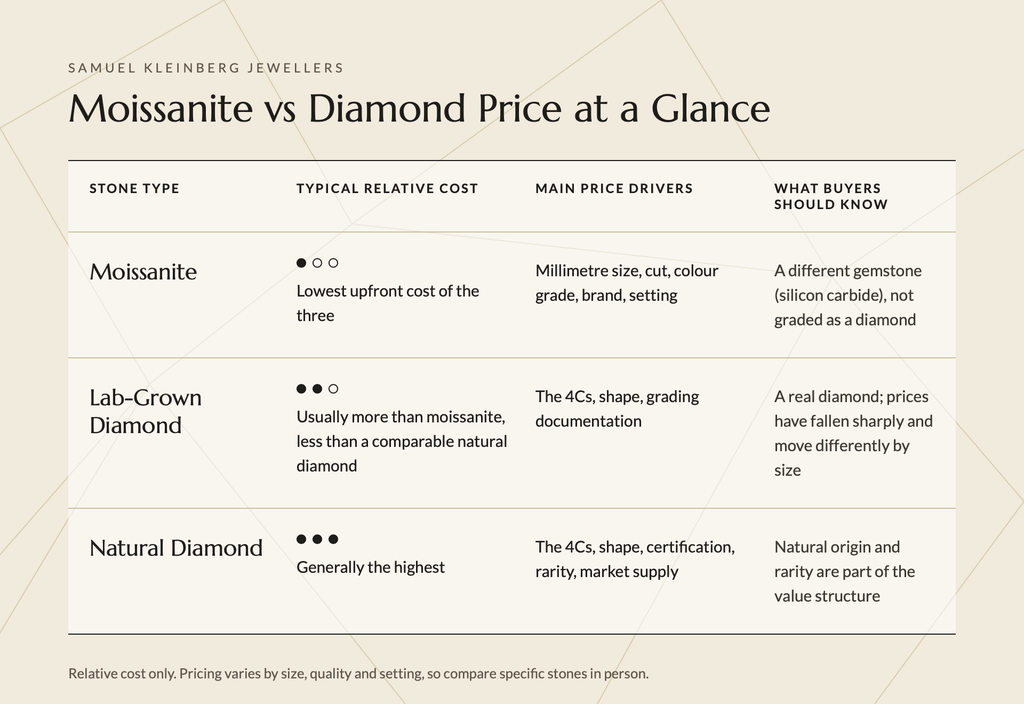
We’ve left fixed dollar figures out on purpose. Lab-grown prices in particular have moved quarter to quarter, so the most reliable number is the one attached to a specific stone you’re looking at today.
Why Is Moissanite Usually Less Expensive Than Diamond?
Moissanite is produced for jewellery and industrial use, so its supply works very differently from natural diamonds. A natural diamond’s price reflects mining, sorting, cutting, grading, and the fact that gem-quality rough is rare while demand stays steady.
Lab-grown diamonds are manufactured too, but they’re still diamonds, priced on cut, colour, clarity, and carat. Moissanite uses its own size and quality conventions, so stones that look alike shouldn’t be treated as equal carats or equal materials.
A lower price doesn’t mean lower quality. Moissanite and diamond are simply different products, with different optical characteristics and different markets.
Lab-Grown Diamond vs. Moissanite Price
For budget-conscious couples, lab grown diamond vs moissanite price is often the comparison that matters most.
The core difference is material. A lab-grown diamond is crystallized carbon with the same makeup as a mined stone; we explain how origin shapes price in our guide to lab-grown vs. natural diamonds. Moissanite is silicon carbide. Here in Canada, the Canadian Jewellers Association’s (CJA) advertising guidelines reserve the word “diamond” on its own for natural stones and require lab-grown diamonds to be clearly labelled.
Compare lab-grown diamond and moissanite prices, and the lab-grown diamond will generally cost more for a similar look, since grading, cut, clarity, colour, and certification all feed into it. The gap depends heavily on size. Analyst Edahn Golan’s Q2 2026 wholesale price list, reported by InStore, showed lab-grown prices down 13% year over year, with 2-carat rounds down 20% while 1-carat rounds rose 1%. Our 2-carat lab-grown diamond price guide shows how quickly the numbers change at larger weights.
Couples weighing these two are rarely just chasing the lowest number. They’re balancing diamond status, visible size, sparkle style, and what’s left for the rest of the ring.
Carat Weight vs. Visual Size: Why the Comparison Can Be Misleading
Carat measures weight, not how wide a stone looks. That single fact causes more confusion than anything else when people compare moissanite to diamond.
Moissanite is lighter than diamond for its size. A GIA lab note puts the specific gravity of diamond at 3.52 and moissanite at 3.22, so two stones with the same face-up diameter will weigh different amounts. That’s why moissanite is usually sold by millimetre dimensions or as a “diamond-equivalent” size rather than by its actual carat weight.
So a “1-carat equivalent” moissanite isn’t the same as a one-carat diamond, physically or compositionally. To judge visible size, compare millimetre measurements, shape, and proportions side by side.
How Sparkle Differs Between Moissanite and Diamond
Brilliance is the white light a stone returns, fire is the flashes of rainbow colour, and scintillation is the play of light and dark as it moves.
Moissanite has a dispersion of 0.104, according to GIA’s original study of the material, more than double diamond’s 0.044. That’s why it often shows stronger rainbow fire, especially in larger stones and bright lighting. It’s also doubly refractive, which a trained eye can spot as slightly doubled facet edges under magnification. A well-cut diamond tends to show a more balanced mix of white light, fire, and contrast.
Neither look is objectively better; it comes down to personal taste. And cut quality matters for both: a poorly cut stone underperforms, whatever it’s made of.
Durability and Everyday Wear
Both diamond and moissanite are durable enough for an engagement ring worn every day, as long as they’re set well and cared for.
Diamond is the hardest gemstone, a 10 on the Mohs scale, with outstanding scratch resistance. Moissanite rates about 9.25 in that same GIA study, so it’s also highly scratch-resistant, though it’s a different material with different physical properties.
Hardness isn’t the same as chip-proof. A hard knock on an exposed edge can still damage either stone, so secure prongs, protective settings for pointed shapes, and routine check-ups with your jeweller matter, whichever you choose.
Certification and Documentation: What Buyers Receive
Natural and lab-grown diamonds can come with grading reports from recognized gemological laboratories that confirm what the stone is and describe its quality. Lab-grown documentation has changed recently, though. Since October 1, 2025, GIA has assessed colourless lab-grown diamonds as “Premium” or “Standard” instead of using its natural-diamond grading scale, and it laser-inscribes each one with “Laboratory-Grown” and its assessment number. Other labs, such as IGI, still issue detailed lab-grown reports. Our guide to diamond certification walks through what to look for on any report.
Moissanite may come with manufacturer or retailer documentation, but it isn’t graded as a diamond. And remember: a grading report describes the stone, while an appraisal estimates its replacement value for insurance.
Either way, ask exactly what paperwork comes with the stone and what it verifies.
Resale Value and Long-Term Cost Expectations
No one can promise how a gemstone will resell, and we’d be cautious of anyone who does.
Moissanite is typically bought for its look and affordability, not resale. Lab-grown diamonds behave differently from natural ones because supply keeps expanding and prices keep shifting. Natural diamonds have a more established resale market, though offers still generally sit below retail.
Our advice: choose based on budget, appearance, origin preference, and how you’ll wear the ring, not as a guaranteed investment.
How the Setting Changes the Total Engagement Ring Price
The centre stone is only part of the final price. Metal choice (platinum vs gold), style (solitaire, halo, hidden halo), pavé work, side stones, custom design, and labour all move the number.
That’s where your stone choice reshapes the whole plan. A moissanite centre can free up room for a more detailed setting, a larger look, or a matching band from our diamond eternity rings. A lab-grown or natural diamond usually shifts more of the total toward the centre stone. Our engagement ring budget guide breaks down how couples typically divide spending between the stone, the setting, and everything else.
The practical rule: compare complete ring prices, not loose-stone prices.
Which Offers Better Value for an Engagement Ring?
The best value depends on what you care about most, so here’s where each option tends to come out ahead.
Moissanite May Offer Better Value If
Moissanite is a separate gemstone rather than one of the diamond types, and it shines brightest when:
- Visible Size Comes First: You want the largest look possible while keeping the centre-stone cost low.
- Rainbow Fire Appeals to You: You love strong, colourful flashes and are comfortable choosing a non-diamond gemstone.
- Budget Has Other Jobs: You’d rather put more toward the setting, wedding bands, or the wedding itself.
A Lab-Grown Diamond May Offer Better Value If
- It Has to Be a Diamond: You specifically want a real diamond at a lower price than a comparable natural one.
- Grading Matters: Certification and a traditional diamond appearance are priorities for you.
- You Want More Size or Quality: You’d like to stretch your budget further while still choosing a diamond.
A Natural Diamond May Offer Better Value If
- Origin Is Meaningful: Natural origin, rarity, and traditional provenance matter strongly to you.
- The Budget Fits Comfortably: Your budget supports the size and quality combination you want, whether that’s a solitaire or one of our diamond rings with side stones.
- Rarity Outweighs Size: You value natural origin more than getting the biggest stone for the money.
How to Compare Moissanite and Diamond Before Buying
Photos and spec sheets only take you so far. Before you commit, run through this checklist:
- Check Them in Different Light: Compare stones side by side under store lighting, softer indoor light, and daylight where possible.
- Measure, Don’t Assume: Compare millimetre dimensions instead of relying on carat or “diamond-equivalent” labels.
- Read the Report: For lab-grown or natural diamonds, review the grading report carefully and confirm it matches the stone.
- Ask How Moissanite Is Documented: Find out exactly how the seller describes the stone and what paperwork comes with it.
- Price the Whole Ring: Compare complete engagement rings, not just the loose centre stone.
- Think Long Term: Consider daily wear, setting style, maintenance, origin preference, and what you expect from the ring years from now.
If a diamond is on your shortlist, seeing stones in person makes the decision far easier. At Samuel Kleinberg, we’ve helped Toronto couples choose engagement rings since 1968.
We’ll set natural and lab-grown loose diamonds side by side, walk you through each stone’s documentation, and show you how different settings change the look and the final price. Book an appointment and bring your questions.
Frequently Asked Questions
1. Does Moissanite Look More Colourful Than a Diamond in Photos?
Often, yes. Moissanite can show stronger rainbow fire under certain lighting and camera settings, while diamonds show a different balance of white light, fire, and contrast. Lighting, cut, and size all affect what appears on screen.
2. Can a Moissanite Become Cloudy Over Time?
The stone itself is durable, but oils, soap, and cosmetics can build up and dull its sparkle. Regular cleaning usually restores it; if the haze persists, have a jeweller check it.
3. Can a Moissanite Engagement Ring Be Reset Into a New Setting Later?
Often, yes, as long as the stone’s dimensions, shape, and condition suit the new design. A jeweller should inspect the stone and the setting requirements before any work begins.
4. Does Ring Insurance Work the Same Way for Moissanite and Diamond?
Coverage depends on your insurer, your appraisal, the replacement value, and the policy terms. Many home policies cap jewellery coverage, and the Insurance Bureau of Canada (IBC) has advised getting valuable pieces appraised and adding a rider. Confirm how both the centre stone and the complete ring are documented for your policy.
5. Is Moissanite Easier to Replace If the Stone Is Lost?
Replacement may cost less than a comparable diamond, but availability depends on the exact size, shape, cut style, and brand. The original setting design can also affect how simple a match will be.