

Two stones sit side by side under bright lights. Both sparkle, both look clean, and both are set in polished white gold. One is a diamond. The other could be cubic zirconia, moissanite, or something else entirely. Whether you’re comparing engagement rings, considering a second-hand piece, or wondering about a ring you inherited, understanding the differences between fake diamonds vs. real diamonds starts with one key point: appearance alone doesn’t prove a diamond is real.
When people say “fake diamond,” they usually mean a diamond simulant. That’s a different material, such as cubic zirconia, moissanite, white sapphire, or glass, that is made or chosen to look like a diamond. Lab-grown diamonds don’t belong in this group. They are real diamonds with the same basic chemical composition and crystal structure as natural diamonds. Only their origin differs.
This guide covers what actually separates a diamond from a simulant: composition, sparkle, hardness, durability, testing, grading documentation, and value.
What Is the Difference Between Fake Diamonds and Real Diamonds?
A real diamond is a gemstone made of crystallized carbon. It can form deep in the earth over billions of years or grow in a laboratory over a few weeks. Either way, carbon atoms bonded in a diamond crystal structure make it a diamond. Knowing the different diamond types helps you make sense of the terms you’ll hear when you shop: natural, lab-grown, treated, and more.
A fake diamond, or diamond simulant, is a different material made to look like a diamond. Some simulants are attractive and suit fashion jewellery well. Still, they are not diamonds chemically, physically, or in value.
The real vs. fake diamond question gets tricky because looks can mislead. Small stones, pavé settings, and jewellery-store spotlights can make almost anything glitter. Even an experienced eye can be fooled at a glance.
Real vs. Fake Diamond: Quick Comparison
Side by side, a diamond and a convincing simulant can look almost identical. The differences show up in what the stone is made of, how it holds up, and what documentation stands behind it. Here’s a real vs. fake diamond comparison at a glance.
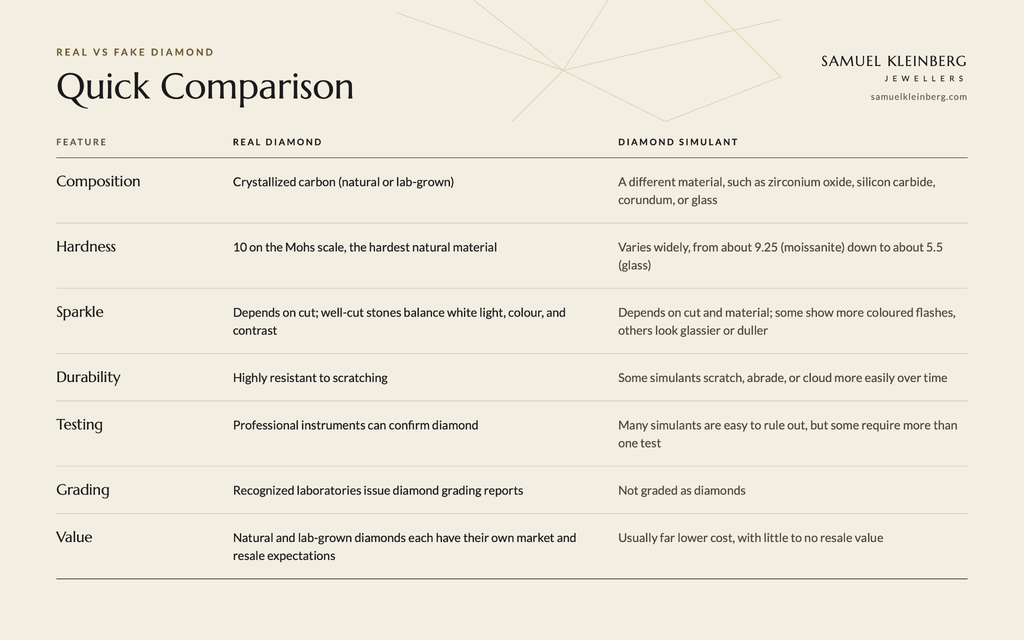
Real Diamond Sparkle vs. Fake: What Does Sparkle Actually Tell You?
Sparkle is the first thing most buyers notice, so it makes sense to start there. Understanding real diamond sparkle vs. fake begins with three terms:
- Brilliance: The white light that reflects to your eye from inside the stone.
- Fire: The flashes of rainbow colour created as light splits into spectral colours.
- Scintillation: The pattern of light and dark flashes you see when the stone, the light, or you move.
A well-cut diamond shows a balanced mix of all three: bright white light, lively fire, and crisp contrast. Simulants can look different. Moissanite often shows stronger, more rainbow-like fire, which some people notice right away in sunlight. Cubic zirconia can look very bright, but its sparkle often has a different depth and pattern. White sapphire tends to look calmer and less lively because its optical properties differ from diamond.
Remember that cut quality affects the look of every stone. A poorly cut diamond can look dull, and a well-cut simulant can look striking. More sparkle does not automatically mean the stone is a real diamond.
Common Stones That Can Look Like Diamonds
These are the materials you’re most likely to find in place of a diamond, especially in older or second-hand jewellery.
Cubic Zirconia
Cubic zirconia (CZ) is a manufactured, low-cost simulant with a bright, clean look. It is softer than diamond and much denser, so a CZ feels heavier than a diamond of the same size. Over time, it may show wear on the facet edges and can look cloudy.
Moissanite
Moissanite is a durable gemstone with strong brilliance and noticeably high fire. Because it conducts heat in a way that resembles diamond, some older single-method diamond testers can mistake it for diamond. Reliable identification often requires instruments that measure both thermal and electrical properties.
White Sapphire
White sapphire is colourless corundum. It can be natural or lab-created, but it is not a diamond. It usually shows less brilliance and fire than a well-cut diamond and can look softer or more subdued. For a side-by-side comparison of looks and durability, read our guide on white sapphire vs. diamond.
Glass and Crystal
Glass and crystal imitations are much softer than diamond, so they scratch and abrade easily. Worn, rounded facet edges can be a clue. Even so, never try to scratch a stone to find out. Professional confirmation is far safer.
How to Tell If a Diamond Is Real at Home
Treat home checks as early clues, not as proof.
- Change the Lighting: Look at the stone in daylight, indoor light, and shade, not only under bright store spotlights.
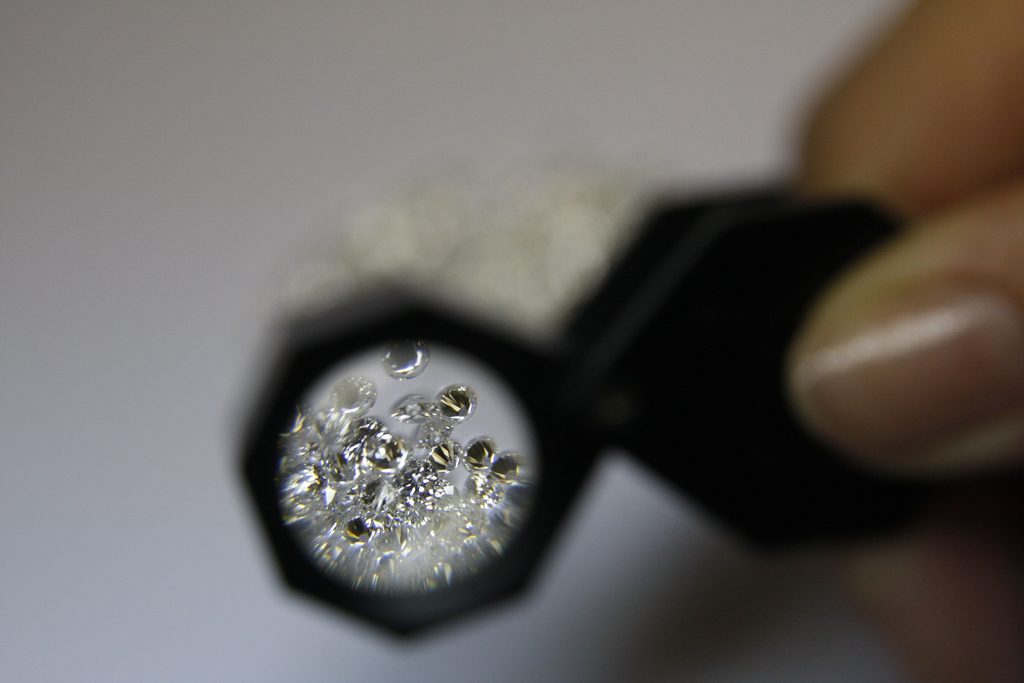
- Use a Loupe: A 10x loupe can show facet wear, rounded edges, gas bubbles, or moulding marks. These are signs to note, not conclusions.
- Check the Setting and Hallmarks: Stamps such as “14K” or “PLAT” tell you about the metal. They do not authenticate the stone.
- Try the Fog Test With Caution: Breathe on the stone. Diamonds tend to clear quickly because they disperse heat well, but humidity, stone size, and surface oils make this test unreliable.
- Skip Destructive Tests: Scratch tests, flame tests, and similar methods can damage the stone, the setting, or both.
For a step-by-step look at safer checks, see our guide on how to tell if a diamond is real. If the answer matters to you financially or emotionally, have the stone verified by a professional.
Professional Tests Used to Identify Real Diamonds
Jewellers and gemologists use instruments and methods that go well beyond what’s possible at home:
- Thermal Conductivity Testing: Diamond moves heat very efficiently, which quickly separates it from materials like cubic zirconia and glass.
- Electrical Conductivity Testing: Moissanite conducts electricity, while most diamonds do not. This makes electrical testing useful when a thermal test alone can’t settle the question.
- Magnification and Microscopy: Inclusions, growth features, and polish marks reveal a lot about what a stone is.
- Spectroscopy and UV Response: Advanced instruments analyze how a stone interacts with light. They help confirm diamond and separate natural from lab-grown.
Mounted stones can be harder to assess than loose diamonds because the setting may block the instrument or hide important features. No single home test should replace a professional gemological assessment when authenticity is uncertain.
Do Diamond Certificates Prove a Diamond Is Real?
A grading report records the identifying and quality characteristics of one specific diamond: measurements, carat weight, colour, cut, and its position on the diamond clarity scale, along with other details.
To be meaningful, the report should come from a recognized gemological laboratory, and it has to match the stone in front of you. Compare the measurements and details, and look for a laser inscription on the girdle where one exists. Many labs offer online verification, such as GIA Report Check.
A grading report is also different from an appraisal, a warranty, or a store receipt. Each serves its own purpose. A printed document alone doesn’t prove the stone you’re holding is the diamond it describes.
Lab-Grown Diamonds Are Real Diamonds, Not Fake Diamonds
Lab-grown diamonds are made using technological processes, but the result is still a diamond. According to the Gemological Institute of America, they share essentially the same chemical, optical and physical properties and crystal structure as natural diamonds.
So the real distinction is origin, not authenticity. Our guide to lab-grown vs. natural diamonds explains how the two compare in price, value, and appeal.
Because the two are so alike, older diamond testers and standard gemological observation can’t separate lab-grown diamonds from natural ones. Specialized equipment is needed, which is why it helps to understand the methods to identify lab-grown diamonds. Lab-grown origin should always be clearly disclosed.
Above all, don’t confuse lab-grown diamonds with moissanite, cubic zirconia, white sapphire, or other simulants. Before you buy, review the grading documentation and confirm how the seller has described the stone’s origin.
Can You Tell a Fake Diamond by Price?
An unusually low price is a good reason to ask more questions. On its own, though, price doesn’t authenticate a stone. When comparing fake diamonds vs. real diamonds, remember that natural diamonds, lab-grown diamonds, and simulants sit in very different price ranges. Prices within each group also vary with carat weight, cut, colour, clarity, shape, brand, setting, and documentation.
Compare like with like. Not every affordable stone is fake, and not every expensive one is genuine.
What to Check Before Buying a Diamond
Use this checklist before you buy:
- Confirm the Stone Type: Ask directly whether it is natural, lab-grown, or a simulant.
- Request Documentation: Ask for the grading report when one applies.
- Match the Report to the Stone: Check the measurements, details, and any inscription.
- Review the Policies: Understand the return, exchange, and warranty terms.
- Compare in Different Lighting: View the stone in more than one lighting condition.
- Ask for Help: Get professional guidance if the terminology, origin, or documentation is unclear.
At Samuel Kleinberg in Toronto, we’re happy to help you compare diamonds in person, walk you through grading documentation, and explain exactly what you’re looking at.
If you’re shopping, explore our diamond engagement rings, browse our diamond rings, or see the continuous sparkle of our diamond eternity rings. Then visit us to see how each one looks in real light.
Frequently Asked Questions
1. Can a Fake Diamond Scratch Glass?
Yes, some can. Many simulants are hard enough to scratch glass, so this isn’t a reliable way to check authenticity. It can also damage your jewellery or other surfaces.
2. Can a Fake Diamond Pass a Diamond Tester?
Sometimes. Testers that measure only thermal conductivity can give moissanite a diamond-like result. Modern professional testing often combines thermal and electrical measurements or uses additional instruments.
3. Can a Jeweller Test a Diamond While It Is Still in a Ring?
Usually, yes. However, the setting can limit access or visibility, so a jeweller or gemologist may recommend further testing in some cases.
4. Does a Real Diamond Always Glow Under UV Light?
No. GIA research found that only about 25% to 35% of diamonds submitted over a decade showed any fluorescence. A UV response alone cannot confirm whether a stone is a diamond.
5. Can Old or Inherited Jewellery Contain Diamond Simulants?
Yes. Both genuine diamonds and simulants have been used in jewellery for generations. If the stone’s history or documentation is unknown, professional identification is the safest way to know what you have.